Wednesday, 31 July 2019

Risking Your Life From Behind a Screen.

Related image
Alaa Basatneh
Most teenagers have social media accounts, only a few risk their lives from behind their screen.

Social media was used effectively during the Syrian Revolution. The Syrian Revolution also known as the Syrian Civil War started on March 15th 2011 and is still ongoing.

In 2011 non-violent protests (the Arab Springs) started against Assad to try and overthrow him as president. 15 Syrian school children were arrested and tortured for grafting inspired by the Arab springs and one of the boys was killed. The arrests caused outrage and protests became more demanding for the release of the remaining children as well as greater freedoms for all citizens of Syria.

Syrian protest
The government responded by arresting and killing hundreds of protesters. This sparked anger among protesters and they started to demand Assad to resign. When Assad refused to step down war broke out between his supporters and his opponents.


Streets of Syria
Social media helped spread the word on how extreme situations were in Syria. Alaa Basatneh was a 19 year old student attending college while risking her life to organize protests in Syria from the comfort of her home in Chicago.


Alaa Basatneh
 Alaa is now 27 years old and has graduated college with a masters in global affairs and security. Alaa still organizes protests and helps where she can in the Syrian civil war but has found that her service is not needed as much as it was back when Chicago Girl was filmed. I reached out to Alaa Basatneh, an activist originally from Damascus Syria but who moved to Chicago USA when she was six months old because conditions got too dangerous for her family to live in.


 I asked Alaa how she thought social media played a role in the Syrian revolution, Alaa replied “social media is a huge tool to help the Syrian Revolution. Activists were able to organize, spread the word through the social media platforms. Without social media we would not have heard about the atrocities that took place on the ground as fast as we have.”

Alaa used Twitter and Skype the most when organizing protests online. She went on to say that organizing protests was not easy and safety was the number one concern, that’s why Alaa used her real name and photos so other activists knew who she was and what she looked like. Without social media we wouldn’t know the full extent of what happened in Syria and it gave people who wouldn’t be able to help or get involved because of political or security reasons a chance to help/donate.


How to get Shut Down on Instagram

Instagram has policies against Ccopyright breaches (posting content copied from the internet or from another account), nudity in photos (although things like cancer scars and breastfeeding are allowed), spamming (repeatedly commenting or contacting people or collecting followers or likes artificially), breaches of the law (no selling weapons or drugs through your account), asks that you respect other members of Instagram, do not glorify self-inflicted injury and that you be considerate of important news events.  

Instagram has a team of people who monitor when accounts are reported and take the appropriate actions to ensure that the situation is managed effectively and professionally. The public is also sometimes able to settle issues with problems like copywriting and trademarking between themselves by filing a report. They advise you don’t overdo it, however, as this can be classified as harassment. 


Reports are the most common way of Instagram becoming aware of accounts that could be fake or scam. After you report an account it can take up to 24 hours for Instagram to view the report and decide on the action it will take. For things like spam or inappropriate content, Instagram would usually send a notice of warning to the account so that they have time to fix their mistake. If the instance is more severe or breaches the Instagram privacy policy however, Instagram has the authority to immediately shut down an account. 

The shutting down of an account is usually controlled by members of the public noticing and reporting content and accounts that could be offensive. Sometimes the content may offend you, as the viewer, but not a general audience. In this case, Instagram suggests that you block the account. This prohibits the account from contacting you or being able to find you the platform. 

Survey
My survey of 100 people showed that around 50% of them have reported an account during their time on social media. 51% said that they had (for various reasons) and 49% said that they had never reported an account or post. The most popular reasons for people reporting accounts were bullying (against themselves or other people) and harassment (people constantly sending them message requests/ inappropriate messages). Other reasons included animal abuse, nudity, hate speech and impersonation 

Of the 100 people who answered, only three had ever had their account reported. The reasons for this were either as a joke or the respondent wasn’t sure. I believe that there is a low amount of people who have had their account reported because the survey was for girls aged between 11-18, and they are probably less likely to post content that others our age find inappropriate. 

Stories of other accounts (not their own) being reported included: a lot of people reporting one account that was posting content that included a person abusing dogs, celebrities posting nude photos, and bullying. These were mainly from accounts that already have a high follower count and are possibly more confident in posting inappropriate content and that more people would notice if they did. Other stories came from people talking about friends or schoolmates who had been bullying others and ended up being reported 

In conclusion, It is relatively hard to have your account officially shut down by Instagram, unless you are doing something very bad. Being reported doesn't necessarily mean that your account will be shut down, it simply allows Instagram to have a look and check that you aren't doing anything against their terms and conditions. The main reasons that teenage girls report accounts are because of bullying or harassment. Most people tend to be fairly aware and careful with what they post themselves, as only three out of one hundred have ever been reported. Overall I think the system is pretty good, however, I know that there will be accounts that manage to slip through the cracks and stay on the platform. 

Self Love vs Beauty Standards

Has social media impacted our perception of physical beauty? 
It’s not surprising to find pictures of bikini clad models with hourglass figures and influencers with flawless skin when scrolling through Instagram, but are these images having more impact on us than we think?  Our exposure to these ‘perfect’ bodies and faces has the potential to change our expectation of what is beautiful, and what features are worthy of likes, comments and praise. But it’s up to us whether we let these images have a negative effect on us and the way we view ourselves and others. 

Has social media changed our perception of physical beauty? 

As increasing amounts of models are appearing on our Instagram feeds, is this changing our expectation of what is perceived as ‘beautiful’? Or is the more recent self-love movement making a comeback on these unrealistic expectations by shedding a light on diversity and beauty positivity 
We surveyed 40 teenage girls aged between 14 – 17 and here’s what we found: 
  • 17 out of 40 girls felt that they were more impacted by seeing unrealistic beauty images such as models with ‘perfect’ bodies and faces, generally commenting that they were impacted by this because of the exposure these images get, being praised and idolized by their many followers and promoting unrealistic standards for young girls to compare themselves to.  
  • 16 out of 40 girls felt more impacted by positive beauty images / messages being spread on Instagram because they choose to surround themselves with these positive posts on social media, often making them feel more positive and confident in themselves.   
  • 7 felt neither or both. 
Regarding our question ‘Has social media changed our perception of physical beauty?’ here’s what our survey showed: 
  • 11 out of 40 girls said that Instagram has not changed their perception of physical beauty, generally commenting that they don’t follow models / influencers who promote unrealistic beauty standards, or they simply choose not to compare themselves to these images or let them change the way they see themselves. 
  •  23 out of 40 girls felt that Instagram has changed their perception of physical beauty because they feel that they need to live up to the unrealistic beauty standards and expectations that Instagram has created in order to feel ‘beautiful’ and ‘worthy’.  
  •  6 didn’t know. 
But, has the more recent self-love movement on Instagram made a comeback on these unrealistic standards that have been created by ‘perfect’ models and influencers? Here’s what our survey found: 
  • 4 out of 40 said no, believing that the self-love movement doesn’t quite live up to the hype around beauty standards on Instagram. 
  • 18 out of 40 said yes, because this movement is spreading awareness and promoting diversity and acceptance which is often more welcomed than unrealistic beauty standards. 
  • 17 didn’t know. 
So, what conclusion does this lead us to? From the data gathered in our survey, we can conclude that generally, people feel that Instagram has changed their perception of physical beauty because of the expectations it has created around body image etc, giving us standards to compare ourselves to and making us think there is a specific way we should look in order to be deemed ‘beautiful’ or worthy of praise. 
However, around half said that self-love and diversity images can impact them more, and around half believe that this positive movement is combatting the unrealistic beauty standards we see on Instagram everyday. So, whilst Instagram may have changed our perception of physical beauty, there is still room for awareness and positivity to be spread around self-love and body positivity. You can make a difference to the beauty expectations we feel are placed upon us by spreading positive massages and promoting self love and diversity. 


How Much of their Social Media Life do Teenagers Share with their Parents?

Most teenage girls have social media but how many of their parents know what they really do on the online world?

Students were asked "How much of your social media life do you share with your parents? Why/why not?"

A survey of 50 teenage girls showed that they share varying amounts of social media with their parents.

Thirteen shared nothing with their parents for the following reasons...

 -It's not their business
 -I don't want them to find out stuff
 -They wont feel happy about how I use it

6 out of the 50 shared everything of their online life with their parents all for the same reason of 'I have nothing to hide.'

31 out of 50 shared a little bit of their social media with their parents because...

 -They won't understand
 -My messages are private
 -Different levels of trust

It was surprising that a couple of people felt that their parents would be disappointed in the way they use social media and that the majority of people shared a little bit with their parents.


How Snapchat Affects Our Mental Health

Image result for snapchat 

  
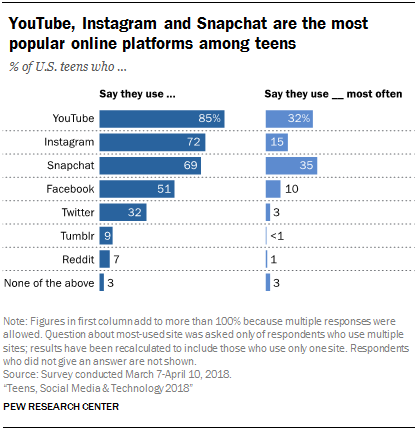
Snapchat is a fun and easy way to connect with people around the world by privately messaging or snapping photos or videos of things that you have done or things that are going on in the moment. This app is an easy way of communicating online with others and is the third most popular social media app in the US.

YouTube, Instagram and Snapchat are the most popular online platforms among teens 
As the years have gone by more and more people are using this app, even celebrities are. It definitely affects our lives fairly significantly. In the time that it has been out our generation has become so dependent on smart phones and the online world. We think with people sharing their world so much on videos and photos that they sometimes forget they are even in the moment. 

We rely on our smart devices to hold memories instead of living for the moment.  

Negative mental impacts from using Snapchat include things like Anxiety, Loneliness and Depression. Looking at carefully filtered pictures of other teens and tweens can also lead to eating disorders, fear of missing out and bullying.  


A recent survey by the Royal Society of Public Health and Young Health Movement of 1,500 people across the UK aged 14-24 found which social media they think impacts their mental health based on the 4 mental well-being issues ranging from anxiety, loneliness to community building and body shaming. Snapchat was one of the worst

Snapchat focuses heavily on photos, which can be difficult for teens and young adults dealing with self-esteem issues. Among those who suffered the most from Snapchat were teen girls, who are also one of the biggest user groups. One of the respondents from the survey said that photo sharing apps like Snapchat make it easy for girls to feel their bodies aren't good enough. 

This graph shows when people use social media...  


Image result for snapchat how effect our mental health 

You only live life once so don't spend all of your life social media!